Bonnie Ervin MSW
Research Associate/ PhD Candidate
Human & Social Dimensions of Science & Technology
College of Global Futures Arizona State University
Guardrails, Not Guidelines: PIT in Embedded Governance
Public Interest Technology shouldn’t be tacked on after systems are built. It should act as guardrails — guiding design and governance from the start, keeping equity and responsibility embedded at every level.
This work reframes PIT from a static tool to a living process, grounded in lived experience, structural awareness, and frontline wisdom.
About Me
Bonnie Ervin
I'm a fourth-year doctoral candidate in Human and Social Dimensions of Science & Technology at Arizona State University's College of Global Futures, where my research examines digital governance, public interest technology, and the emerging stakes of AI governance for public services.I came to this work as a practitioner. I've built action-oriented internship programs, led innovative service-learning projects across disciplines, and worked across sectors where translation between research, policy, and practice is the actual job. That orientation — solution-focused, community-grounded, interprofessional by default — shapes the questions I ask and the kinds of answers I find useful. I look for structural patterns, design for durability, and treat lived experience and frontline knowledge as core expertise.In 2025, I earned an International Doctoral Certificate in Responsible Innovation through Delft University of Technology, Karlsruhe Institute of Technology, and Arizona State University, bringing a global, ethics-driven lens to questions of equity and technology policy.

Dissertation Research
Governance by Portal:
Digital Public Services in Practice
My research examines how digital public-service systems shape access to essential resources for marginalized populations, particularly older adults experiencing homelessness. Drawing on theories of Relational Poverty, Street-level Bureaucracy, Digital Health Equity, and Public Interest Technology, I investigate how increasingly digitized systems for housing, healthcare, benefits, and social services redistribute responsibility onto individuals and frontline workers who must navigate complex technological and institutional barriers.My dissertation introduces the concept of Digital System Mitigation Labor (DSML), which describes the often invisible labor performed by frontline staff, peer workers, and community organizations to compensate for gaps, failures, and assumptions embedded within digital systems. This work includes tasks such as troubleshooting online portals, translating bureaucratic requirements, reconstructing digital identities, and helping clients navigate fragmented service infrastructures. Rather than viewing exclusion primarily as a matter of individual digital literacy, this research reframes digital inequities as structural and policy-driven phenomena.Methodologically, the project combines qualitative interviews, community-engaged research, and the development of Digital Environment Tests (DETs), an applied framework for examining how digital public-service systems function under real-world conditions. DETs evaluate how institutional assumptions, policy requirements, and platform design shape lived experiences of access, exclusion, and navigation burden.More broadly, this research contributes to emerging conversations in science and technology studies, digital governance, and public interest technology by exploring how technological systems quietly function as governance infrastructures. The project aims to inform more equitable approaches to policy, service design, and technological implementation for underserved populations.
Focus Areas:
- Digital exclusion and health
- Aging, housing insecurity, and tech equity
- Frontline workers as ethical navigators
- Governance and public interest technology as equity by design processMethods:
- Trauma-informed interviews
- Field-based ethnography
- Systems mapping
- Public value framing
Public Interest Technology in
Community Co-Design Processes

Public Interest Technology for Digital Health Equity
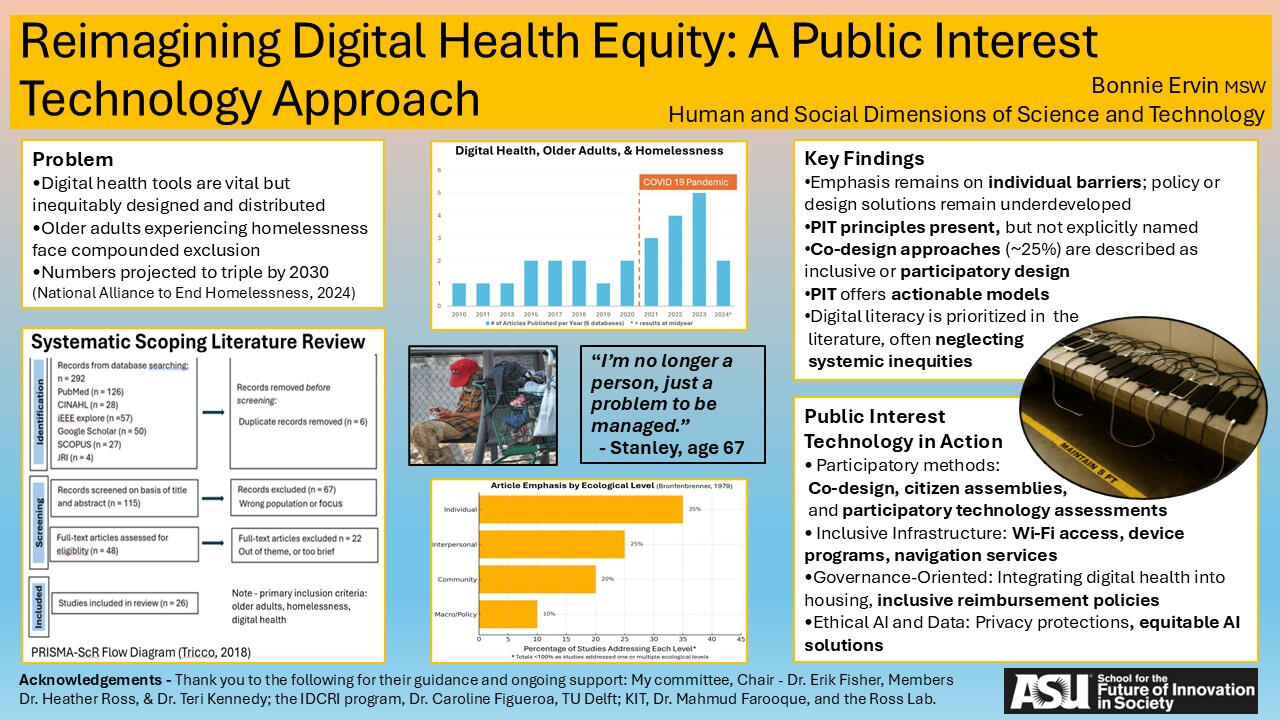
Reimagining Digital Health Equity: A Public Interest Technology Approach (Ervin, 2024) is a systematic scoping review of how digital health interventions for older adults experiencing homelessness are designed, framed, and evaluated in the existing literature. The review finds that most interventions emphasize individual barriers (digital literacy, device access) over structural ones (policy design, service infrastructure), and that PIT principles — co-design, participatory methods, community accountability — are often present but rarely named. The full poster is available below.